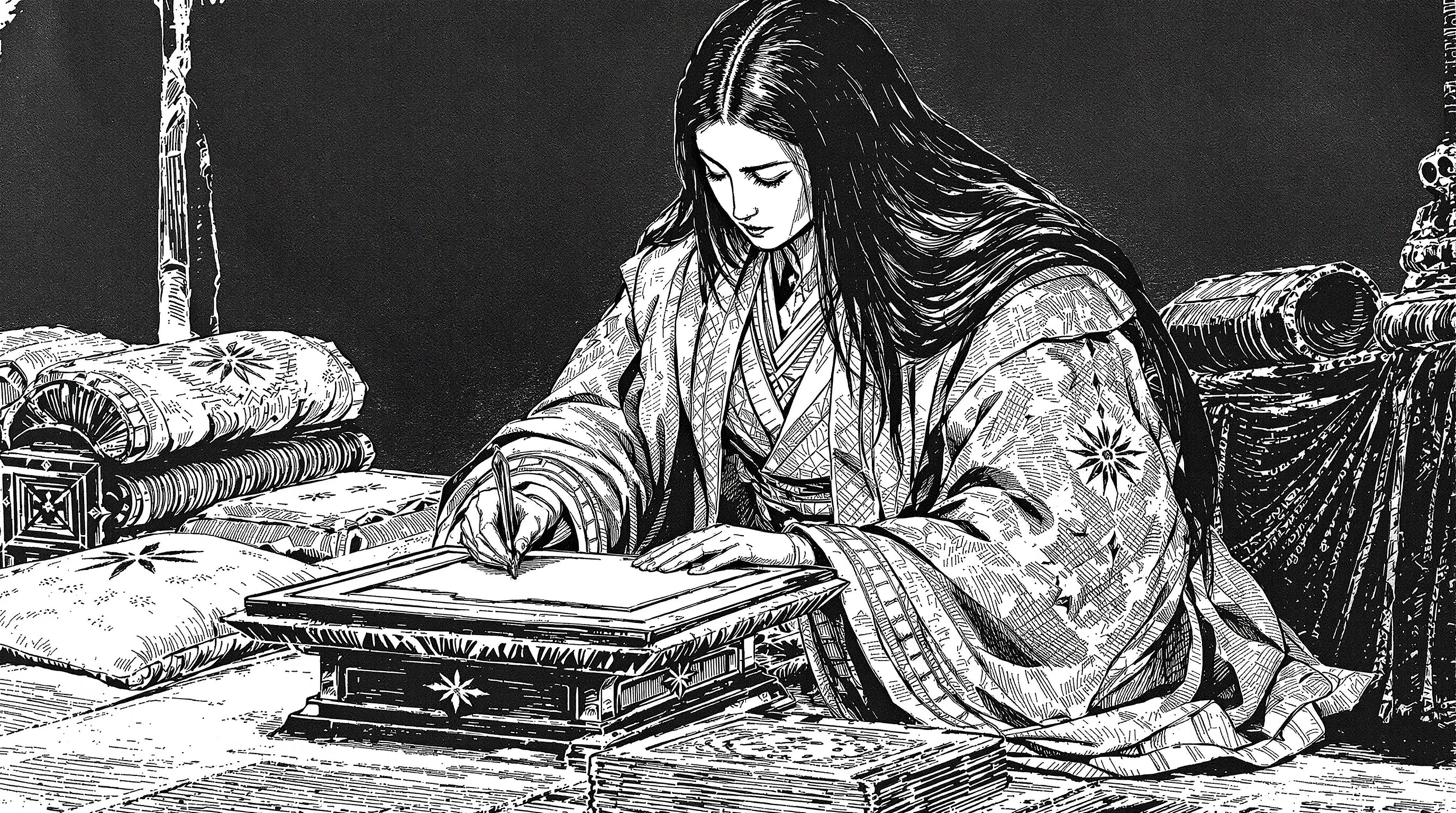
Sei Shōnagon's lists
Annoying things, tiresome things: the courtier's commonplace under headings.
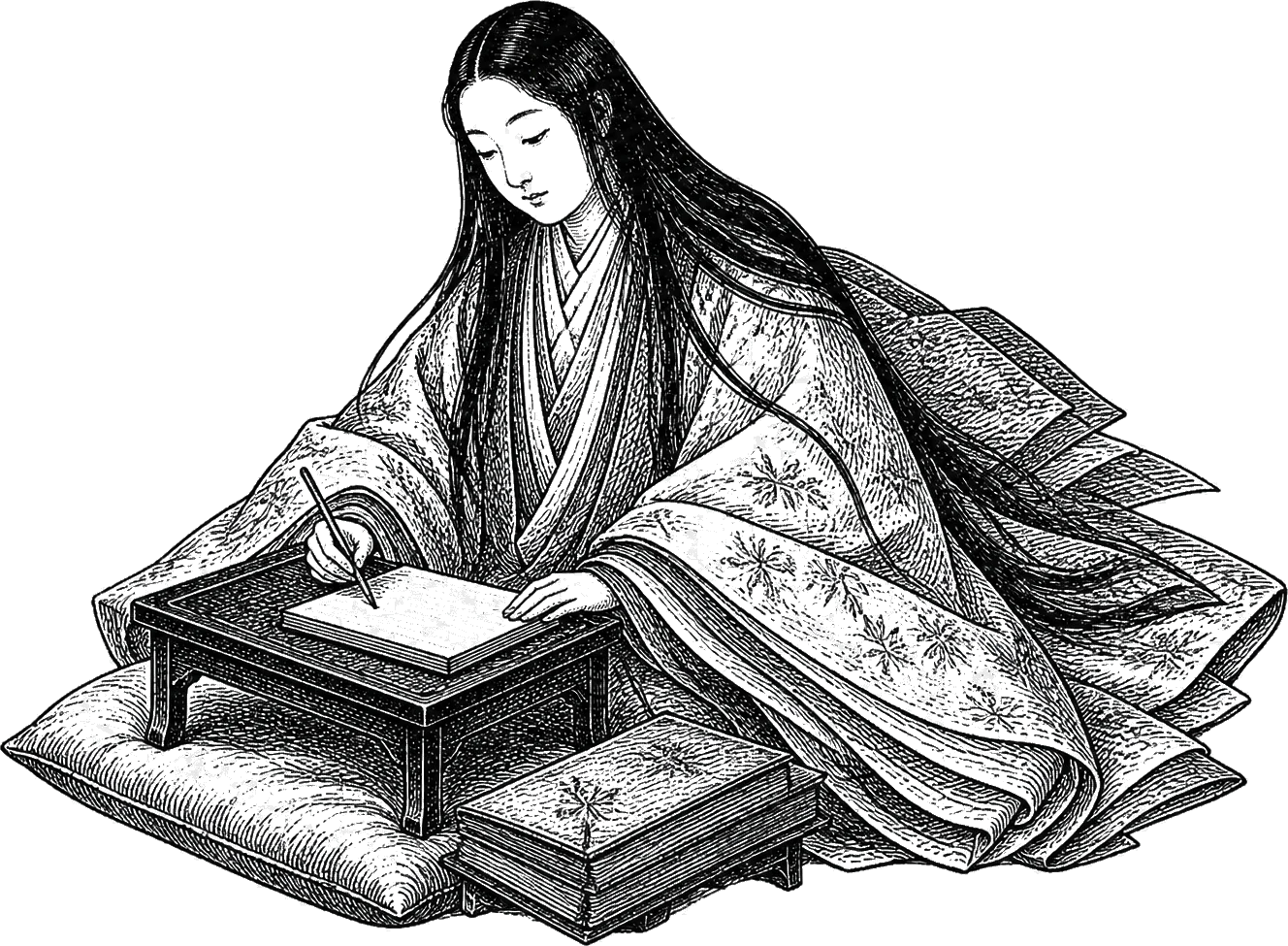
The courtier who kept under headings.
Annoying things, tiresome things, and the ones that stayed lists.
Sei Shōnagon kept her Pillow Book at the Heian court around the year 1000: not as a finished tale, but as a keeper’s commonplace under headings. Waley’s open English on Wikisource prints the book as “flashing impressions,” and his public-domain text groups entries under Disagreeable Things, Amusing Things, Disappointing Things, and the like. The scheme sometimes breaks; the items do not.
She protested the book was for herself alone. Then a visitor sat on a mattress where it lay, carried it off, and handed it round. So far as she remembered, that was the beginning of its circulation at Court.
Under the stray notes she sets the returned letter: one has taken particular trouble to get it up prettily; at last one’s own note comes back, finger-marked and smudged, the messenger saying the family is not in residence, or that it is a day of observance and they would not take letters in. “Such experiences are dismally depressing.”
She sets the wrong knock: one has been expecting someone; rather late at night there is a stealthy tapping; the maid returns with a name that does not concern one at all. “Of all depressing experiences, this is by far the worst.”
She sets the lover at dawn who must hunt for a fan or pocket-book in the dark, fumbling, knocking into everything, muttering “How very odd!” until when he finally leaves, “instead of experiencing the feelings of regret proper to such an occasion, one merely feels irritated at his clumsiness.”
Elsewhere the keeper records how a lover ought to depart: coaxing, unfinished whispers, the shutters raised together. But if he springs up with a jerk and fusses round, tightening his waistband, thrusting odds and ends into the folds of his dress: “one begins to hate him.”
The lists are not ornaments. They are annotations of taste and temper: what annoys, what tires, what makes one happy. Getting hold of stories none of which one has read before. Finding the second volume of a tale one could previously get only as Vol. 1. Picking up a letter someone has torn and thrown away, and fitting the pieces well enough to make sense. An upsetting dream, and the interpreter who says it does not signify anything in particular.
What she actually kept was not a court chronicle. It was an item under a heading: a recollection, an irritation, a small happiness, ready for a later reading, or for none.
How to keep a commonplace book · The letter · 1 · Opuss on the App Store
Sources: Sei Shōnagon, The Pillow Book, translated by Arthur Waley, open on Wikisource. Stray notes as printed there; headings and “Things that make one Happy” also in Waley’s public-domain text on Project Gutenberg.
You may also like
The letter
Read issue 1. Ten we kept this week, and how to keep your own. Or start with how to keep.